
Foundations for Shared Progress: Why Public Investment in Science Powers Us All
Europe's future depends on investing in curiosity, people, and purpose.

We live in an age of astounding technological progress, but it’s easy to forget where much of it truly begins: not in corporate labs, but in the publicly funded, curiosity-driven world of basic scientific research. From the internet to artificial intelligence (AI), the foundations of today’s most transformative innovations were laid decades earlier by researchers in publicly supported institutions—often universities—working without immediate commercial aims.
This isn’t just a feel-good story about the value of knowledge. It has urgent policy consequences. If public investment catalyses private innovation, then the benefits of those innovations should flow back to society. We need to expand our framing—beyond debates over inequality or corporate concentration—toward a more ambitious vision: a loop of shared progress, in which public investment seeds private success, which in turn reinforces public prosperity.
Where Do Innovations Really Come From?
One of the most compelling illustrations of this dynamic is the so-called U.S. “tire tracks” diagram for information technology (IT).
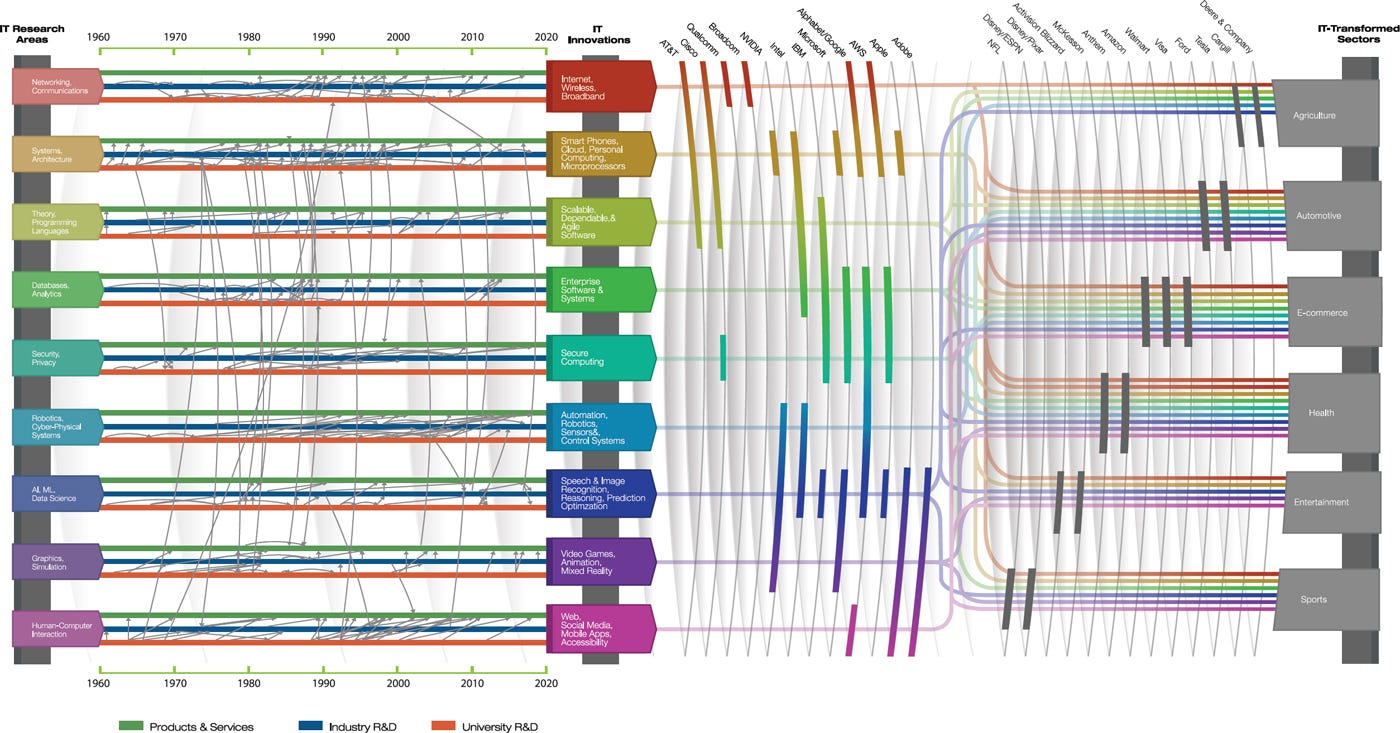
Source: National Academies of Sciences, Engineering, and Medicine. 2020. Information Technology Innovation: Resurgence, Confluence, and Continuing Impact. Washington, DC: The National Academies Press. https://doi.org/10.17226/25961.
Originally developed in the 1990s and periodically updated, this figure traces how long-term, federally funded research—largely conducted in universities—has paved the way for entirely new (multibillion-dollar) industries. Crucially, this kind of basic research is often too risky or long-horizon for private actors to justify. But over time, it yields powerful returns.
Open-source software, often incubated in academic settings, amplifies these returns by making foundational tools widely and cheaply available, spurring new waves of innovation across sectors. This long-standing public-private interplay is the backbone of technological progress. The ecosystem works best when governments invest in infrastructure, talent, and freedom of inquiry, and when this work is protected from short-term political or commercial pressures.
Recent cuts to science funding in the U.S., therefore, risk becoming a self-inflicted wound. Europe should take note.

Europe’s Strategic Moment: Horizon Europe and Beyond
The EU’s flagship programme, Horizon Europe, offers a powerful case study in the long-term payoff of public investment. According to a recent evaluation:
For every euro of costs to EU society, the programme is expected to generate up to six euros in benefits by 2045. In terms of economic growth, each euro invested is estimated to generate up to €11 in GDP gains.
— Interim Evaluation of Horizon Europe, 2025.
This isn’t surprising if we treat research as what it is: a public good. But returns like these don’t happen by default. They depend on strategic, stable, and sufficient funding.
In fact, Horizon Europe could help deliver the EU’s fifth freedom—the free movement of knowledge—on par with goods, services, capital, and people. This is essential for building a 21st-century knowledge economy grounded in democratic values and inclusive prosperity.
What the EU Budget Should Prioritise Now
As the EU begins designing its post-2027 budget, policymakers have a critical opportunity to protect this virtuous cycle, while avoiding false choices and zero-sum reallocations. To strengthen the loop of shared progress, EU science policy must:
1. Scale Total R&D Investment, Don’t Just Reallocate
While Horizon Europe plays a vital role, national governments still fund about 90% of public R&D in the EU. Yet most member states fall short of the EU’s longstanding target of investing 3% of GDP in R&D, a benchmark set as far back as 2002. Worse, the EU as a whole still lags behind the U.S. and China in R&D intensity.
We don’t just need to shift resources between national and EU levels—we need to increase overall R&D investment significantly, across both. Europe must treat science as a strategic pillar of sovereignty and resilience, not just an economic tool.
2. Invest in Both Strategic and Curiosity-Driven Research
There is growing concern that future EU research funding might become overly centralised or narrowly focused on short-term policy priorities. While Horizon Europe’s strategic orientation is crucial, especially for transnational public goods like climate and health, it must not replace national funding that supports basic research and academic freedom.
We need both:
EU-level programmes that address collective European challenges, foster collaboration across European regions and leverage scale, and
National (and regional) systems that protect institutional autonomy and foster the long-term exploration where breakthroughs begin.
3. Invest in People, Not Just Projects
Ideas don’t generate themselves. Even in the age of AI, it is people who ask the questions, design the experiments, and translate knowledge into applications. Europe needs to invest in the full arc of scientific careers—from education and training to stable, rewarding employment.
Short-term, precarious contracts and under-resourced institutions are not just bad for individuals—they weaken the knowledge system as a whole. Excellence requires inclusion, infrastructure, and long-term thinking.
Strengthening the Loop: Society>Economy>Society
At the heart of this argument lies a deeper truth: a strong economy is not the end of public investment but the means to shared societal advancement.
Public investment in science and human development builds the foundations for innovation and economic growth. But that’s only half the story. The returns generated in wealth, productivity, and technological progress must flow back into public goods that sustain and uplift society. That’s the virtuous loop we need to reinforce:
→ Society → Economy → Society ↩
Within that loop, a key mechanism is:
→ Public investment → Private innovation → Public benefit ↩
This loop is not automatic. It requires deliberate policy design, stable funding, and an unshakeable belief that science is a foundation of democratic prosperity.