
Futures Sensing for Everyone: How to Detect and Create Signals of Change
A hands-on guide to spotting early signs of change and planting seeds for the future you want.

In a previous Polity Futures post, we explored backcasting as a method for turning desirable futures into concrete action pathways. Backcasting starts with the end in mind and works backwards: What kind of future do we want? What steps would it take to get there?
But knowing where we want to go is only part of the equation. We also need to ask: What’s already emerging now, under the surface? Where are the first hints, however faint, of change taking shape?
This is where signals come in. And the good news is: sensing signals of change is not the exclusive domain of policymakers or think tanks. Artists, activists, entrepreneurs, scientists, designers and citizens all play a role. Anyone can learn to detect early signs of transformation—and just as importantly, anyone can help create them.
Signals remind us that the future is something we help create. When we approach the future as a design challenge, early signs of change become raw material for imagination and action. They encourage us to pay attention to what’s emerging and to participate in shaping what comes next.
I. What Are Signals? And Why Should You Care?
A signal is a sign that something new might be starting.
It’s an event, behaviour, idea or development that feels novel or slightly out of place—but might grow into something significant. Think of signals as the early, often overlooked signs of change. They can show up in art, technology, policy experiments, social norms or even memes. And unlike trends, which are established patterns, signals are often fragmentary and hard to interpret.
Some signals stay at the margins, while others become the seeds of future systems.
Signals are different from trends and drivers. A signal is a new or surprising event, idea or behaviour that hints at emerging change. Trends are broader patterns we can already observe, while drivers are deep, structural forces shaping long-term change, like demographic shifts or climate instability. Signals often appear before trends form, and noticing them early can offer a strategic edge.
Signals help us anticipate change before it solidifies. They offer an early warning or early opportunity. For individuals and communities, signals invite us to act with greater creativity and foresight. For institutions, they allow for more adaptive governance, shifting from reactive to anticipatory.
But there’s another, subtler reason to care: Signal sensing rewires our attention. In a noisy information landscape, it trains us to notice what usually gets ignored. It rewards curiosity, interdisciplinarity and openness to surprise—qualities our political systems often lack.
II. Where to Look: Tools and Habits for Sensing Signals
The good news is that signals are everywhere. The challenge is learning to see them.
You’re unlikely to find them in government white papers or front-page news. Signals tend to live on the margins—at the edges of disciplines, in subcultures or in early-stage research, startups and art projects. Sometimes they’re visible only in hindsight. But with the right tools and habits, anyone can learn to spot them earlier.
Here are some ways to build your signal-sensing capacity:
Expand Your Field of View
Look outside your usual information bubble. Try exploring:
Emerging tech communities (e.g. open-source forums, digital cooperatives),
Art and speculative fiction (often imagining alternative futures before they’re real),
Policy experiments and local innovations (e.g. participatory budgeting pilots, legal sandboxes).
A helpful lens is the STEEP framework, which entails scanning across Social, Technological, Economic, Environmental, and Political domains. This ensures a broad base for pattern recognition.
Keep a Signal Journal
Start a low-stakes habit of jotting down things that feel unusual, unexpected or oddly resonant. You might include:
A new kind of business model or protest tactic,
An article or tweet that sticks in your mind for reasons you can’t explain,
A new form of collaboration you’ve never seen before.
Over time, patterns emerge.
Start a Swipe File
Create a folder—digital or physical—for things that feel like signals. Articles, photos, drawings, tweets, prototypes, podcast moments. The only rule: it has to spark a flicker of “this could be something.”
With time, you’ll develop your own sensing system.
III. How to Create a Signal
We can discover signals, but more importantly, we can also create them.
Any early-stage act that hints at new possibilities can become a signal. That includes prototypes, performances, experiments, phrases or even small, unexpected behaviours. The more a signal resonates, travels or inspires imitation, the more likely it is to shape future patterns.
You don’t need to know how big an impact something will have to start. In fact, many meaningful signals begin as small acts of dissent or imagination.
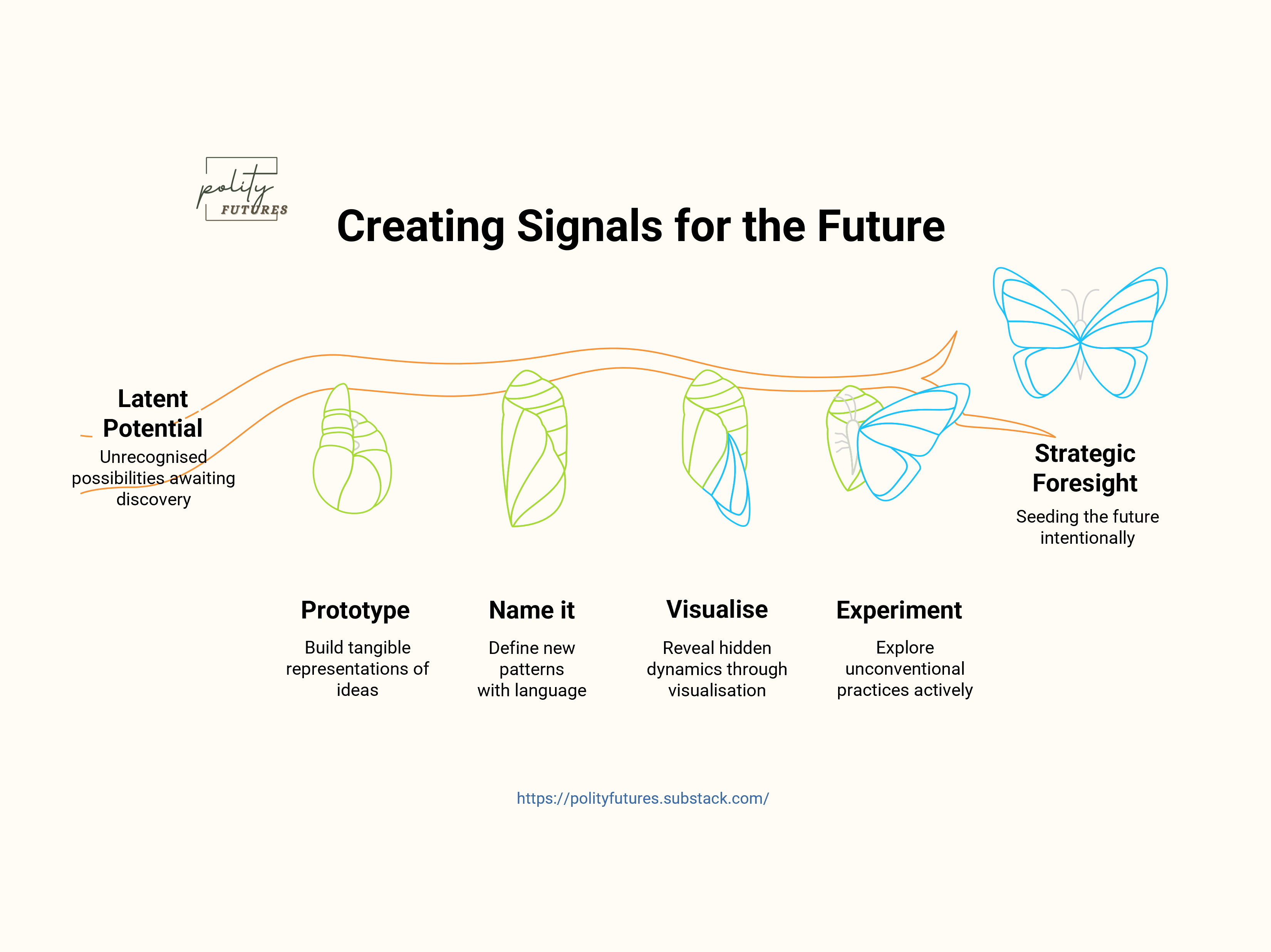
Here are some ways individuals and communities can plant signals:
Prototype a new possibility: Create something tangible, however rough—an app, a community event, a mutual aid model.
Name what doesn’t yet exist: Coin a phrase or metaphor that helps others see a new pattern (think “doughnut economics” or “long COVID”).
Make the invisible visible: Use art, storytelling or mapping to bring overlooked dynamics into public view.
Experiment at the margins: Try out an unconventional practice, introduce a new community habit or explore alternative ways of making collective decisions.
Signals often emerge unintentionally, but intentional signal creation is a form of strategic foresight. It’s a way to seed futures.
Example: A small group of researchers and farmers in a rural region begins experimenting with open-source agroecological methods, documenting their process and results in plain language through a shared online notebook. Over time, the initiative draws attention from nearby communities, researchers and municipal policymakers. What began as a modest experiment becomes a signal of a new, collaborative model for place-based rural innovation, grounded in shared knowledge and local capacity.
IV. Making Sense of Signals
Not every strange thing is a signal and not every signal means something lasting. The key is sensemaking: the process of interpreting what a signal might mean, in context.
When you spot something that feels like a signal, ask yourself:
Could this scale or spread?
What dominant assumptions does it challenge or invert?
If this became normal, how would it reshape a system?
Sensemaking is about tracing connections between weak signals and larger systemic possibilities.
Some practical tools for making sense:
Pattern clustering: Collect 10–15 signals over time. Use sticky notes or a digital tool (like Miro or Obsidian) to look for patterns. Do certain themes or tensions recur?
Future snapshots: Imagine a future in which this signal has gone mainstream. What changes? What stays the same?
Oppositional pairing: For each signal, find a counter-signal. What does this reveal about tensions or forks in the road?
Sensemaking is imaginative. It invites us to see the present differently and to notice which futures are struggling to be born.
V. Sharing and Connecting Signals
A signal grows stronger the more it is seen, debated and recombined. Sharing your signals—whether ones you’ve spotted or ones you’ve created—is a way of contributing to collective foresight.
Here are some ways to share and connect signals:
Start a public signal log: A blog, Substack series or shared Google Doc where you periodically post what you’re noticing.
Join or create a networked scanning group: Foresight communities like Futures Centre or curated platforms like The Living Library often welcome contributors.
Feed upward and outward: Share signals with local institutions, community media or policymakers. You never know where a fringe insight might land.
The point is not to predict but to provide perspective. When more people share what they’re seeing, we build a richer, more plural understanding of the emerging now.
Remember: The future is a commons. Signal work is one way to steward it.
VI. Futures as a Shared Sensing Practice
Backcasting invites us to build paths towards futures we want. Signal sensing helps us notice the futures already trying to emerge—sometimes quietly, at the edges.
You don’t need credentials to participate in this work. You just need curiosity, a bit of structure and a willingness to look beyond the obvious.
To close, here are two questions worth keeping in your back pocket:
What’s something I’ve noticed lately that others seem to overlook?
What small act could I take that might become a signal of a better future?
In a world shaped by complexity and surprise, it’s not enough to plan—we have to listen ahead. The signals are already there. What we do with them is up to us. And when we treat the future as a design challenge, we reclaim our collective agency to both respond to and shape the deeper patterns of what comes next.