
The Signal #3
Tyranny of averages or why poverty targets risk leaving the most vulnerable behind.


In early February, the European Parliament adopted an ambitious resolution calling for the eradication of poverty in the European Union by 2035. It’s the right goal, and the horizon is realistic. But if history is any guide, the challenge will be ensuring that policies actually reach the households they are meant to help.
I have previously described what I call the “second policy valley of death”: the gap between policy implementation and effective distribution. Governments and international institutions tend to design programs that improve averages, raising the minimum income by a few percentage points or increasing social transfers in aggregate, but fail to ensure that these gains touch the lives of the people in deepest need. This is the valley into which many well-intentioned policies fall, and it is precisely the risk the EU faces in pursuing its 2035 poverty target.
The Parliament’s proposals emphasise a combination of measures: minimum income schemes, targeted child benefits and social investment strategies designed to address both income and opportunity gaps. These instruments are well-established, and their political visibility sends a strong signal of intent. Yet, ambition alone does not guarantee effectiveness. Historical approaches to social policy and investment strategies of the last decade suggest that policy outputs often diverge from policy outcomes. Programs are designed with universality in mind, but the realities of administrative bottlenecks, regional disparities and the informal economy mean that the most marginalised frequently remain outside the system.
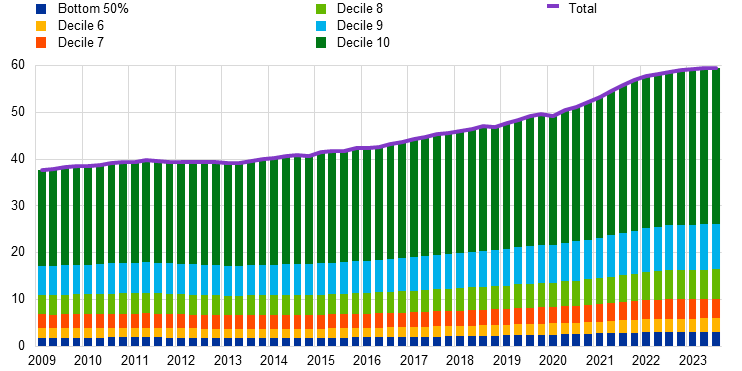
Part of the problem lies in how we measure success. For decades, policymakers relied primarily on average metrics: GDP per capita, median income or poverty rates calculated across entire populations. While these statistics provide a broad brushstroke of societal progress, they obscure the distributional realities within populations. In recent years, this has begun to change. The United Nations has incorporated distributional national accounts (DNA) into its standard framework, allowing analysts to examine how income, consumption, and savings are spread across the population. The European Central Bank has developed distributional wealth accounts (DWA) to capture similar nuances in household wealth.
These innovations are important. They mark a shift from thinking in averages to thinking in distributions, acknowledging that aggregate improvements do not automatically translate into improved outcomes for the least advantaged. But while distributional accounts illuminate gaps, they are not a panacea. Often expert-driven and applied in a top-down manner, these frameworks add nuance without fundamentally changing the mechanics of policy delivery. A country may now know that the bottom quintile is being left behind, but unless programs are explicitly designed to reach them, knowledge alone does not close the gap.
This is the crux of the second valley of death: policies optimise statistics and dashboards, but fail to alter lived reality. Without closing the gap between design and distribution, ambitious targets, such as eradicating poverty by 2035, risk becoming symbolic declarations instead of the transformative change they are promising. The danger is insidious failure, because it fails those who are struggling the most, for whom the promise of social protection remains perpetually aspirational.
Under the Sustainable Development Goals, governments, including every European country, committed to eradicating extreme poverty by 2030. That pledge is now widely expected to be missed. Why do such commitments fail to discipline policy choices? When targets are detached from distributional design, accountability mechanisms, and real implementation pathways, they become weak signals of intent rather than obligations to deliver. Aspirational goals are not taken seriously because they are not embedded in systems that make failure politically, fiscally, or institutionally costly.
Bridging this valley requires a new mindset. First, distribution must be a design principle, not an afterthought. Policies should be tested and adapted to the realities of the households they intend to reach, integrating mechanisms that account for access barriers, regional disparities and informal economic activity. Second, participatory implementation can ensure that beneficiaries have a voice in shaping how programs operate on the ground, creating feedback loops that reveal gaps and inefficiencies early. Third, policymakers must embrace systems thinking, acknowledging that poverty is multidimensional, encompassing income, opportunity, health and agency, and that interventions in one domain can have unintended consequences in others.
Europe has shown political will, and it surely possesses the technical expertise and fiscal capacity to make poverty eradication a reality. What it lacks is the bridge between policy promise and lived impact. As the EU charts a course toward 2035, and as long as political will not falter, closing the second policy valley must become a central part of the strategy. Otherwise, the continent risks repeating a familiar pattern: policies that improve averages while leaving the most vulnerable behind.
The ambition to eradicate poverty is commendable, even historic. But it will only be realised when Europe shifts its focus from outputs to outcomes, from averages to agency, and from policy intent to lived impact. Until then, the second valley of death will remain wide, and the promise of 2035 may remain just that: a promise.
What I’m reading this week:
—
Let me know your thoughts,
Sanja

If you enjoyed this piece, you might also want to check out: