
When Markets Undervalue What Matters
Upholding human-centered values in a market-driven knowledge economy.

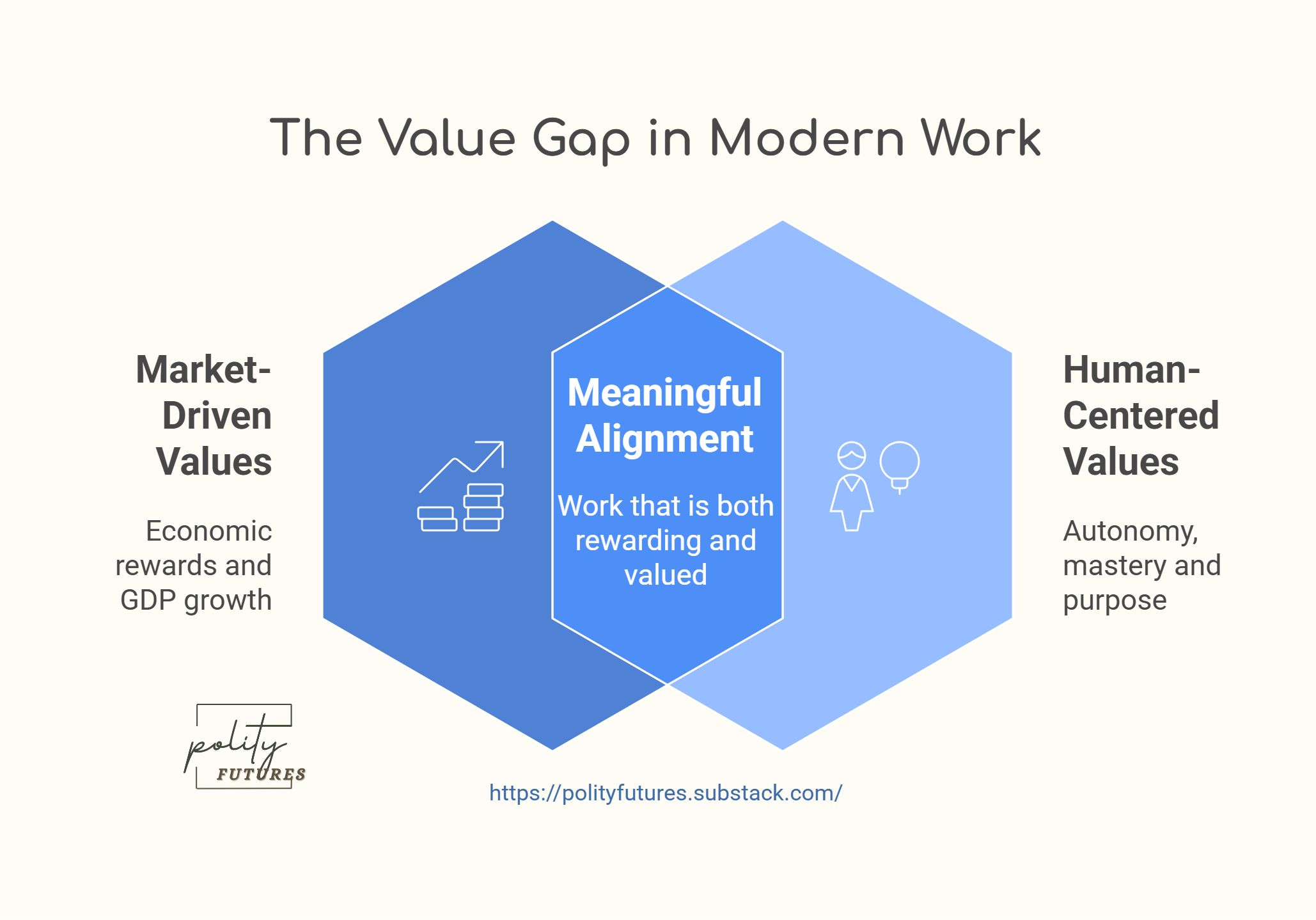
What happens when the things people value—autonomy, mastery, purpose—don’t align with what the market rewards? We live in societies where market prices are assumed to reveal value and GDP growth is taken as a proxy for progress. But this assumption fails to capture the realities of work, motivation and meaning—especially in knowledge-based and public-good-oriented professions.
This points to a structural tension at the heart of today’s political economy: the market is a powerful coordinator of effort, but it is not designed to uphold the values people care most deeply about, particularly as workers, professionals and citizens.
What People Actually Value
Psychological research indicates that people thrive when they experience autonomy (a sense of agency), mastery (the ability to improve and grow) and purpose (the feeling that their work matters). These are prerequisites for wellbeing, motivation and dignity. In his widely read book Drive, Daniel Pink synthesised decades of behavioural research to argue that these intrinsic motivators are far more effective and satisfying than external rewards like money or status alone. But there’s a problem: what’s good for people isn’t always good for profit.
In many sectors of today’s economy, these qualities are hard to find and harder to keep. Instead, workers face escalating demands, declining security and limited say over how their work is done. The result is a widespread sense of alienation and frustration, particularly among highly skilled professionals who entered their fields with strong intrinsic motivations.
This disconnect reflects the deeper logic of systems built to optimise for price and productivity, not for purpose or professional fulfilment. And nowhere is this clearer than in the case of research and academia.
The Erosion of Professional Autonomy: The Case of Research Careers
Even professions that once promised autonomy—such as academic research—are increasingly shaped by market logics that erode independence, continuity and public purpose. The traditional idea of the researcher as an autonomous professional pursuing open-ended inquiry, accountable to disciplinary standards and societal relevance, is being replaced by the figure of the grant-seeking project manager, accountable to funder priorities and institutional performance metrics.
This shift is well documented by the OECD, including within the Research and Innovation Careers Observatory (ReICO), which tracks systemic pressures on research careers globally. A central finding is the growing projectification of research: careers are increasingly organised around short-term, externally funded projects rather than long-term academic appointments or stable institutional mandates. This model fragments researchers’ trajectories, disrupts intellectual continuity and undermines the capacity to take intellectual risks.
What does this mean in practice?
Instead of building cumulative expertise, early-career researchers often move from one project to the next, adjusting their focus to fit what is fundable rather than what is important. The pressure to secure external funding—combined with evaluation systems based on publication counts, impact factors and citation metrics—drives conformity. It discourages interdisciplinary or critical work and often penalises slower, exploratory modes of inquiry.
Precarity compounds the problem. Many researchers, especially postdoctoral fellows and non-tenured staff, work under temporary contracts with uncertain prospects. Their time is increasingly consumed by grant writing, administrative tasks and performance reporting. The very conditions that once defined academic work, such as autonomy, continuity and a sense of contribution to collective knowledge, are displaced by competitive individualism, managerial oversight and short-term deliverables.
The consequences are structural, not just personal
Importantly, this is not only about the pressures placed on individual researchers. It is also about how universities themselves—public institutions historically tasked with stewarding knowledge for the common good—are increasingly required to play by market rules. Whether through competitive rankings that shape institutional strategy, funding models that tie budgets to third-party income or reforms that introduce corporate governance practices, universities are structurally incentivised to behave like market actors. They compete for reputation, funding and students in ways that reshape their internal priorities and external roles.
This reveals a deeper tension, one that extends beyond overwork or funding scarcity. It is a shift in the governance of knowledge production, where economic and managerial rationales overrule epistemic ones. As universities adopt quasi-corporate structures and seek to compete in global rankings, research becomes instrumentalised. Outputs are judged not by the insight or public value they generate, but by their alignment with audit regimes and reputational indicators.
Incentives override intrinsic motivation
The result is a growing disconnect between what researchers are trained and motivated to do and what institutional systems incentivise. Autonomy is narrowed to the tactical choice of which funder to pursue or how to frame a proposal for maximum visibility. Mastery is subordinated to speed and scale. Purpose is squeezed into logics of impact measurement that often fail to capture social or scientific value in a meaningful way.
This erosion is often justified in the language of modernisation, excellence or innovation. Yet the deeper effect is a narrowing of intellectual life and a weakening of the university’s role as a critical institution. When research is valued only insofar as it can be commodified, monetised or ranked, we risk losing not only good jobs but also good knowledge. This creates a feedback loop: institutions optimise for what is measurable and fundable, which in turn reshapes academic priorities and professional norms. Research is judged by its (measurable) impact metrics, not its insight.
The academic profession is not an isolated case. But it is an instructive one. It shows how systems designed around market proxies for value can hollow out the very capabilities—like autonomy, creativity and care for the long-term—that societies rely on to adapt, learn and act wisely.
The Market's Logic and Its Limits
Markets are powerful tools for organising production and allocating resources. But they are not neutral arbiters of worth. What markets value is exchange value: what can be priced, bought and sold. When this logic governs not only commodities, but also labour, knowledge and public institutions, it begins to shape what gets done and how.
Much of what people care most deeply about, especially in fields like education, care and research, does not lend itself easily to pricing. The result is a profound mismatch: market mechanisms reward efficiency, visibility and short-term outputs, while undervaluing the slower, less measurable work of judgment, depth and care.
This becomes particularly evident when considering professional mastery. Mastery takes time, continuity and the freedom to develop expertise through reflection and experience. But marketised systems, driven by competition and metrics, often favour speed, novelty and scale over depth. In such environments, mastery is squeezed out by multitasking, grant-chasing and performance audits.
Institutional logic shapes how technology is used
This tension is now visible in how institutions respond to AI and automation. AI could free researchers to think more deeply, but in today’s institutions, it mostly helps them publish more papers, faster.
In research, AI tools may streamline data analysis or generate literature reviews, but under current institutional pressures, they risk reinforcing a "publish or perish" culture by accelerating volume over value. When technology is deployed to optimise outputs rather than expand judgment, it becomes another layer in the system that displaces mastery rather than deepens it.
The underlying issue isn’t technology itself, but the institutional logic into which it is embedded. In a system where value is equated with measurable productivity, the introduction of AI can flatten the space for human insight. Instead of freeing time for inquiry or deliberation, it may intensify existing pressures, raising expectations without changing the incentives. Ironically, what should be tools of liberation become tools of intensification.
This is not inevitable. It is a consequence of how we structure systems of reward and accountability. Left unchecked, market proxies displace more meaningful assessments of value. The challenge, then, is not rejecting markets or technology, but recognising their limits, and designing institutions that defend space for human values that markets alone cannot uphold.
Why This Matters for Policymaking
The mismatch between what markets value and what people value is a systemic challenge that affects how we govern work, knowledge and public goods. If institutions like universities must behave like businesses to survive, we need to ask: what kind of economy have we built, and what alternatives are possible?
Rethinking value means taking seriously the experiences of professionals whose work matters to society but is undervalued by market standards. It means designing policies that support autonomy, continuity and purpose, not just productivity. And it means confronting the structural forces that hollow out public institutions from within, even as they are tasked with addressing our most urgent challenges.
This series will explore how we might do that.