
When Progress Gets Measured by the Wrong Things
Measuring value in today's and tomorrow's knowledge economies.

In Part 1 of this series on rethinking value beyond GDP in our increasingly knowledge-oriented society, we examined a deep mismatch at the heart of today’s political economy: markets reward what is visible and tradable, but people and societies thrive on values that often defy pricing, such as autonomy and purpose.
This tension plays out not just at the level of individuals and professions, but also in how we measure economic progress and design policy around those measurements. The core metrics we rely on, especially GDP, were developed in an earlier economic era. They struggle to capture the realities of today’s knowledge- and intangible-based economy, and even more so, the kind of future economy we urgently need to build.
GDP and the Intangible Economy: A Mismatch of Logic
Gross Domestic Product was designed to track market transactions in an economy dominated by tangible goods: steel, cars, oil, agriculture. In that context, price and output could act as rough proxies for economic value.
Today, the most valuable assets are intangible, such as data, ideas, designs, relationships, algorithms and organisational culture. In sectors like research, education, media and digital services, value is created less through the production of things and more through the coordination and sharing of knowledge.
GDP struggles here. It counts the market sale of a book, but not the knowledge it imparts. It accounts for software licensing fees, but not the open-source infrastructure that underpins the internet. It captures the cost of a university course, but not the long-term impact of education on a person’s agency or civic contribution.
Moreover, GDP ignores how public investment fuels private innovation. Research funded by taxpayers may generate breakthroughs that drive entire industries, but those benefits are only counted if and when they are monetised. This is a structural blind spot. GDP reflects the logic of markets, not the logic of social value. And as the economy becomes more intangible, that gap grows wider.
Zero Marginal Costs and Missed Signals
This shift also upends basic economic assumptions. Much of neoclassical economics is based on scarcity and marginal cost pricing. But intangible goods like knowledge or software can often be replicated at near-zero marginal cost. That’s why one journal article, dataset or digital tool can be shared globally at almost no expense, if allowed.
Yet under market logic, such goods are often locked behind paywalls or proprietary platforms, even if publicly funded. Artificial scarcity is introduced to extract revenue. This makes sense for private profit, but not for societal benefit.
Markets are powerful tools for organising production and allocating resources. But they are not neutral arbiters of worth. What markets value is exchange value: what can be priced, bought and sold. When this logic governs not only commodities, but also labour, knowledge and public institutions, it begins to shape what gets done and how.

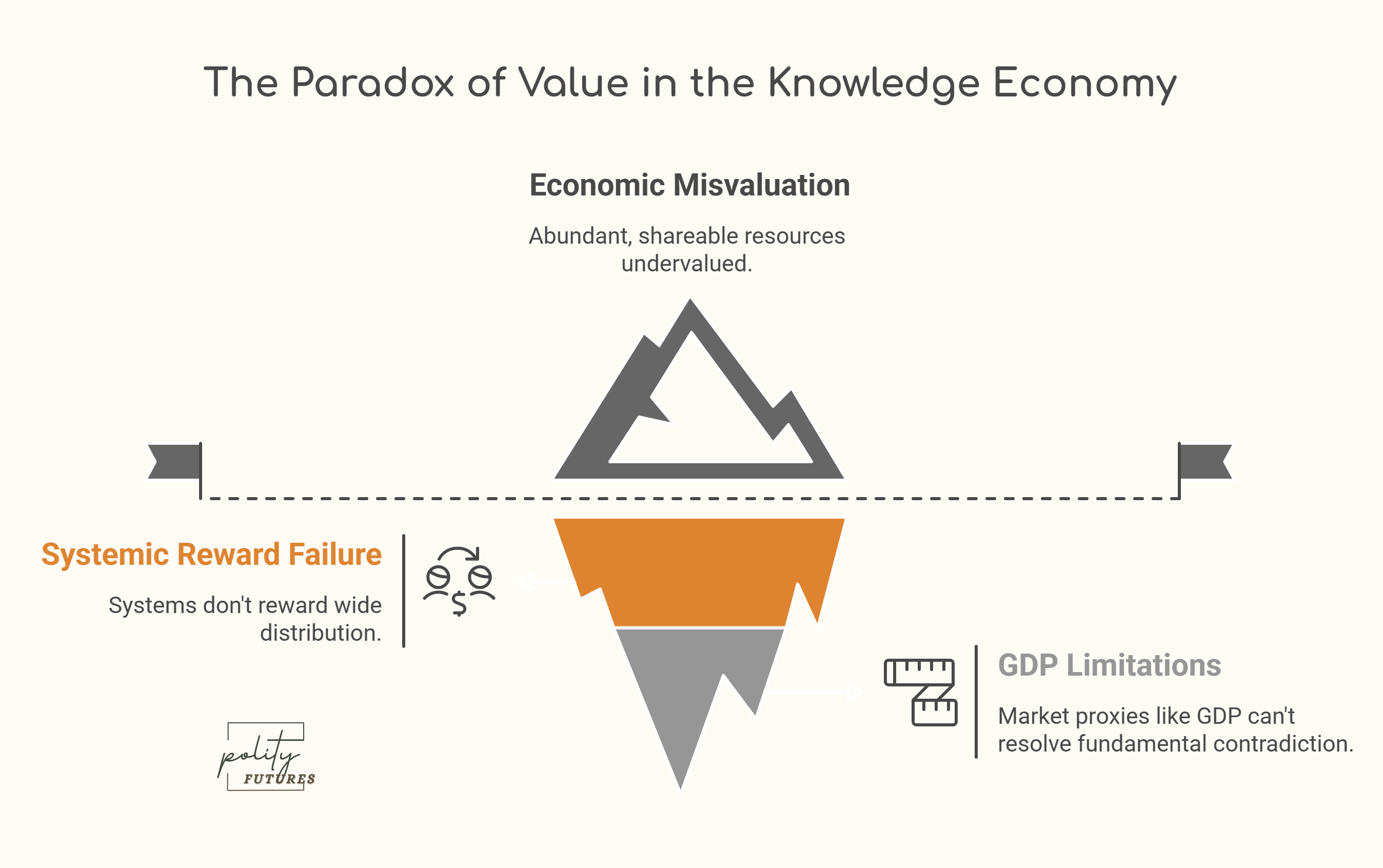
The most socially valuable things in the knowledge economy, because they are abundant and shareable, often don’t count as valuable in traditional economic terms. Our systems fail to reward what should be most widely distributed. This is a fundamental contradiction that GDP and market-based proxies can’t resolve.
Scientific Publishing: A Telling Case
This tension is clearly visible in how scientific knowledge is produced and distributed. Most academic research is publicly funded. It is conducted in institutions that serve the public interest. Yet the results are often published in journals owned by commercial publishers, behind expensive subscription paywalls.
Here, a near-zero marginal cost good (a digital article) becomes artificially scarce to sustain high profit margins. Meanwhile, researchers and universities must pay to access the very knowledge they helped produce. Those without resources, whether in poorer countries, smaller institutions or independent practice, are locked out.
Even more, what counts as valuable knowledge is filtered through proxies like journal prestige and impact factors, which distort research agendas and career incentives. Instead of encouraging deep or long-term inquiry, these metrics often reward trendy topics, superficial novelty or conformity to mainstream disciplinary norms.
Open access publishing offers an alternative, but it exposes the deeper misalignment between public value and market viability. Open access models aim to make knowledge freely available to all. Yet these are often more expensive for authors and institutions, requiring upfront fees (article processing charges or APCs) to replace the revenue lost from subscriptions. This shifts the cost burden onto researchers or their institutions, many of which are already financially stretched.
Paradoxically, the publishing model that best serves the public interest—free and open access to knowledge—can be the most difficult to sustain within a profit-driven system. Commercial publishers have little incentive to adopt models that threaten their revenue streams. Meanwhile, community-governed and non-profit alternatives often struggle to compete for visibility, legitimacy or funding in a landscape shaped by market logic and prestige hierarchies.
The result is a knowledge system where societal value is structurally undervalued. The most accessible and equitable forms of dissemination that reduce barriers, foster collaboration and democratise knowledge are rarely the most profitable. In fact, they often require cross-subsidies, philanthropic support or public investment precisely because markets fail to reward them.
While the publishing system is only one part of the larger knowledge economy, it offers a stark example of how profit-maximising logics can displace public purpose and how our dominant measures of success can mislead us rather than guide.
Beyond Proxies: Reclaiming Public Value in Knowledge Systems
Whether we look at GDP or research citation counts, a similar problem emerges: we’ve built systems that confuse what is measurable with what is meaningful.
This is not a call to abandon measurement. It’s a call to choose better measures and to remain clear-eyed about what measurement can and cannot do. The most important dimensions of public value, such as trust, depth, openness, long-term orientation and epistemic diversity, are not always easy to quantify. Worse, they may be actively undermined by the very metrics we use to signal excellence or success.
Scientific publishing metrics offer a case in point. Citation counts and journal impact factors were originally designed as heuristics to trace influence. But they now operate as high-stakes signals that shape funding decisions, hiring, promotions and institutional reputation. As a result, they incentivise behaviours that maximise citations rather than contribute meaningfully to knowledge or society.
This is part of a broader challenge in the knowledge economy about the growing gap between how value is created and how it is recognised. Ideas do not depreciate with use; they multiply. Shared knowledge can benefit everyone without being depleted. Yet our systems still treat knowledge like a rivalrous commodity, measured and allocated through logics of scarcity.
Reclaiming public value in such a context means rethinking the governance, funding and evaluation of knowledge institutions. A healthier knowledge economy would support open, community-governed publishing models, prioritise equitable access to information and measure research success in terms of contribution, relevance and integrity, not just visibility or citation volume.
As societies confront complex, interdependent challenges, we need knowledge systems capable of producing insight, cultivating trust and enabling action. That will require institutions that recognise and reward the true sources of public value, even when they resist easy quantification.
Why This Matters for Policymaking
If we continue to manage the economy with tools built for another era, we will misdiagnose our problems and misdirect our responses.
GDP and traditional economic indicators were designed to track scarce and tradable goods, not abundant, relational or collective assets. They can’t account for the richness of intangible value creation and they actively discourage investment in areas like knowledge commons, institutional trust and long-term capacity.
To align policymaking with the realities of a knowledge-based, technologically mediated society, we need new indicators and new priorities. We need to design institutions and policies that reward care, stewardship and contribution, alongside output and efficiency.
Next in this series, we’ll explore ways to begin doing that.